
Every corner of Harlem has a story. Some are written on plaques. Some live in photographs. Some are still carried in the memories of neighbors who know what a block used to sound like on a summer evening.
This week, we’re stopping at Carmansville, the vanished village above 145th Street.
At first glance, Carmansville might seem like nothing more than a name on a playground sign. But if we slow down for a moment, we find a story about ambition, change, and how a whole neighborhood can disappear without anyone noticing.
Here’s the mini history lesson
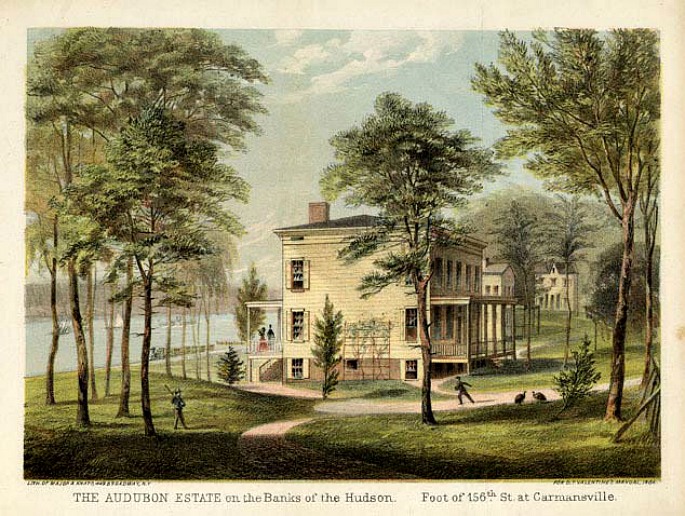
In the mid-1800s, Richard Carman, a wealthy landowner who made his fortune helping rebuild New York after the Great Fire of 1835, gave his name to a little village on the Hudson River bluffs. Carmansville sat in what is now Hamilton Heights, with most accounts placing it between about 152nd and 157th Streets and some stretching it from 140th to 158th. It had its own blacksmith, grocery, school, and church — a self-contained village years before Manhattan’s grid arrived.
It was also a place for people who could afford a view. The naturalist John James Audubon lived nearby on his estate, Minniesland. A magazine writer in 1868 described trim hedges and flowering shrubs lining the gravel walks that led from the road to the villas. The railroad even named its stop at 152nd Street after the village.
Then the city came north. By the late 1800s, tenements and apartment buildings were replacing the estates, wealthy families moved on, and the village slowly dissolved into the grid. The name faded from maps and from memory.
What makes this story worth remembering is that Harlem has always been a neighborhood of neighborhoods, and some of them left no monuments, only traces.
Harlem’s history is not only about famous names or landmark events. It is also about the everyday places where people gathered, worked, worshiped, performed, argued, dreamed, and built something that lasted.
A detail to notice
In December 1913, the city gave a small park on Amsterdam Avenue, between 151st and 152nd Streets, the name Carmansville Playground, chosen specifically “to preserve the former designation of this section of the City.” More than a century later, it is still one of the only places where the village’s name survives in public.
Why it still matters
Carmansville reminds us that the borders we take for granted, where Harlem ends and Hamilton Heights begins, were drawn and redrawn over time. Knowing about the villages underneath today’s blocks changes how you read the neighborhood: the hill, the river views, and the street names all start to look like clues.
Before you go, next time you pass Carmansville Playground on Amsterdam Avenue at 151st Street, take one slow look around. Harlem has a way of hiding whole chapters in plain sight.
Kid’s Corner - The Harlem time Trotters
Episode 2 P is for Porch - Maya and King gear up for a casual stroll down historical Astor Row, only to discover they've been transported to 1918 Harlem to help Marcus Garvey realize his dream of starting his influential newspaper amidst fears of backlash.
Street Names – Trivia
Quick: Who is the Southwest corner of East 118th Street and Park Avenue named after?
The answer to last week’s trivia is - A. Philip Randolph Boulevard.
A. Philip Randolph (1889-1979) organized the Brotherhood of Sleeping Car Porters and was a key figure in both the Harlem Renaissance and the Civil Rights movement. He took a stand against segregation in the Armed Forces, calling on blacks to refuse to register for the draft. This led to President Truman’s crucial 1948 Executive Order barring discrimination in the military.
Our favorite film
Relaxed Virtual Screening of San Juan Hill: Manhattan’s Lost Neighborhood
San Juan Hill: Manhattan's Lost Neighborhood, an hour-long documentary directed by Emmy Award winner Stanley Nelson. Through never-before-accessed historical footage, expert commentary, first-person storytelling with former residents, and narration by Academy Award-winning actress Ariana DeBose (West Side Story), San Juan Hill: Manhattan’s Lost Neighborhood traces the San Juan Hill neighborhood’s rise and fall—and celebrates the people, arts, and culture whose enduring legacy still resonates today.
If this story made you think of someone who loves Harlem history, share it with a friend.
Responses